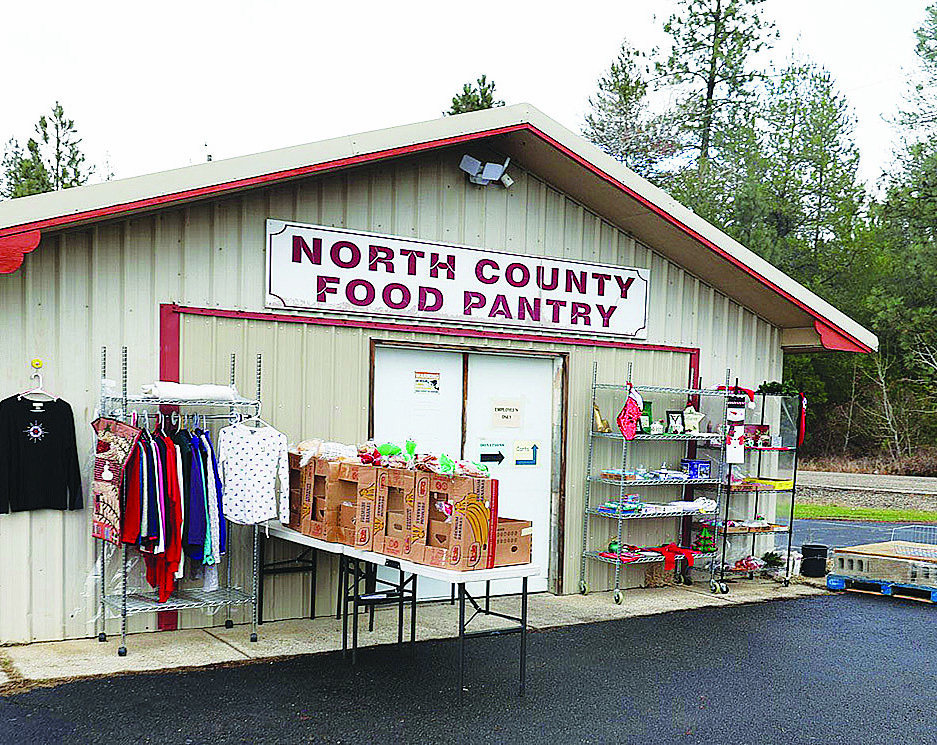


Juxtaposed between pristine forest and charred farmland, a 1982 mobile home in Elk has fed hundreds of families’ stomachs and souls each week for decades.
Inside the North County Food Pantry, the embers in the fireplace crackle as the chatter of voices echoes across the dining room table and into the reception area.
Mike Barnes rests his elbows on a red tablecloth freckled with white cut-out snowflakes. Across from him is Cheryl Ainsworth, a former caregiver who’s been going to the food bank for the past 10 years.
They’re both digging into plates full of ham, mac and cheese, carrot souffle, and cranberry cabbage salad. For dessert, they munch on hot cocoa cupcakes with a candy cane jutting up from the frosting.
While they eat, Barnes speaks about the weather, or what life is like in his fifth-wheeler. He said he was kicked out of the house he used to live in by his ex-girlfriend’s “no-good” son when he used to live in the Bay Area. He moved to Elk for a fresh start. Ainsworth, meanwhile, started going to the pantry with the elderly couple she used to care for. She kept returning to North County, even when the couple died.
In the span of just a few minutes, someone new sits down at the table with a plate. And then another. Each person takes about 30 minutes to finish their food, drink a cup of coffee and have a conversation with their neighbor about anything that might seem relevant. Then they leave, and more people come to take their spot over the course of three and a half hours.
Much like Ainsworth and Barnes, the pantry is full of familiar faces. For many, the appeal isn’t just about the meals. It’s the simple fact that other people care about their wellbeing.
Benevolent brothers
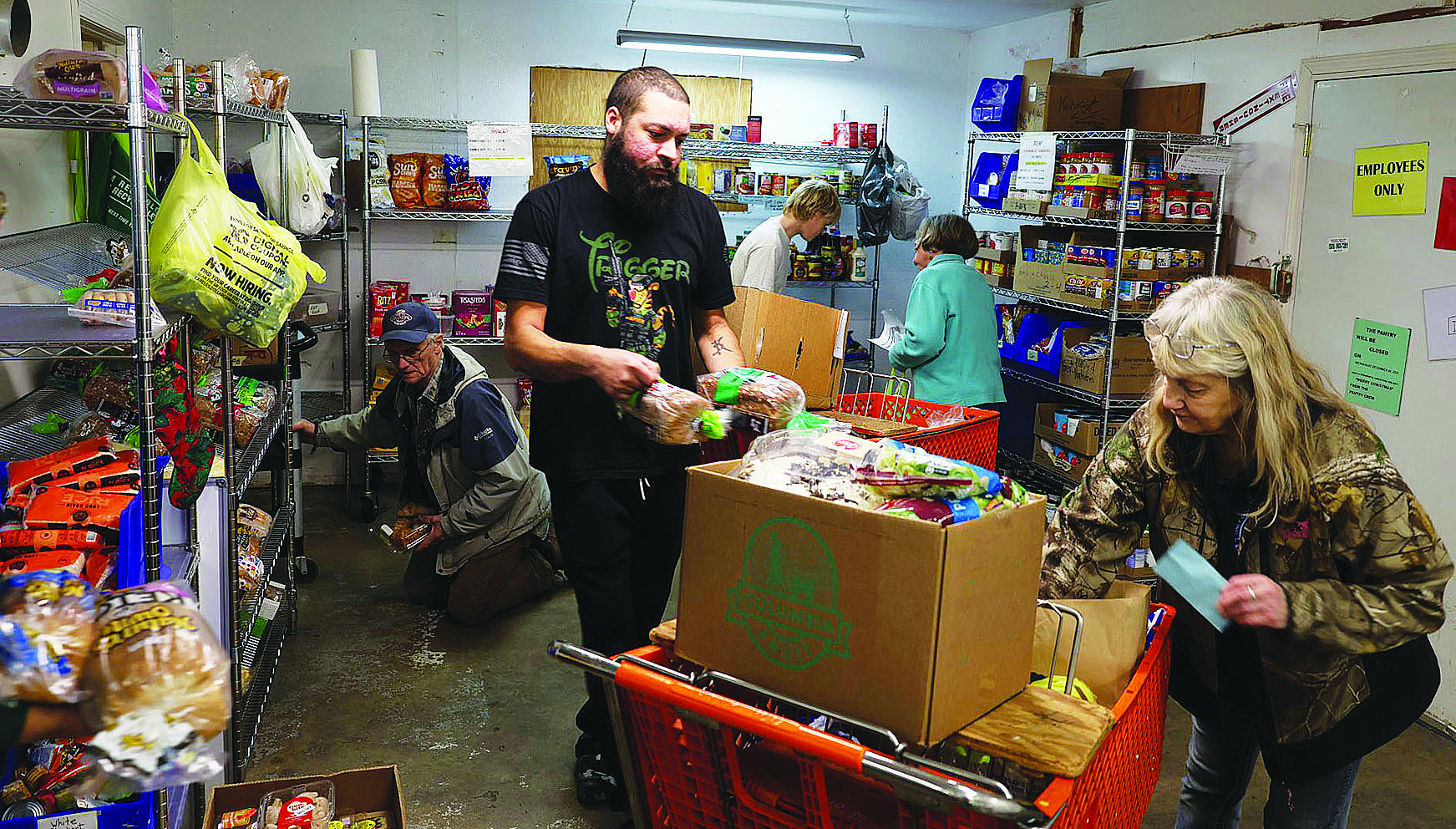
Twelve-year-old Ryder Beck and his brother, 14-year-old Rowdy, also find time to sit at the table – at least, when they’re not busy reorganizing the warehouse section of the pantry or filling retrofitted carts with goodies people need.
The home-schooled brothers began volunteering at the food pantry four years ago. At 8 and 10, they decided (not their mother, they were quick to point out) that they wanted to do something to keep their hands busy when they weren’t learning. Now, they’re at North County every Monday and Wednesday filling carts, moving boxes of produce and helping out in the garden. The pantry is split into two parts: one is dedicated to the dining room, while the other half is their grocery store-esque storehouse, with a vast walk-in freezer, fresh fruit, bundles of bread and much more.
Clients can eat a meal in the dining room and then head to the storehouse section and, with the help of a volunteer, get the food they need for the week. For a family of four, they can take home between 50 and 60 pounds of grub. Larger families, depending on the size, can pick up anywhere from 80 to 120 pounds.
Ryder said they don’t get many opportunities to meet people outside of their family since they’re home-schooled. So working at a food bank twice a week, sometimes more, is a great way to connect. The brothers are the only people under the age of 20, out of the 50 or so monthly volunteers who take time out of their week to help the pantry.
Cooking with love
As the boys talk with the regulars in the quasi-restaurant, a father-daughter duo bustles about the kitchen a fishing rod length’s away.
On the Monday before Christmas, Dawn Harmsen takes carrot souffle out of the oven, while her father, Roger Becker, prepares the salad, wearing a green, Grinchthemed beanie.
The pair come in on Mondays to cook for members of the community after doing six to eight hours of prep work the night before. For their Christmas meal, they chose to make baked ham and carrot souffle to provide something special, something that people might not usually cook for themselves.
Harmsen worked in a corporate office for a car company before retiring in 2018. Both she and her father wanted to find something to do with the extra time. They landed on volunteering at the food bank together after seeing an ad in a local newspaper.
“We’re always getting complimented and thanked for the meals all the time,” Becker said. “So every time you think, ‘Well, gee, I should give it up,’ well, then who’s gonna do that for those people?”
But cooking for 70 people, as opposed to half a dozen at a small family gathering, doesn’t come without a fair share of challenges. The top obstacle is finding the middle ground between making too little and too much food, Harmsen said.
The other challenge revolves around keeping Faithful, the giant English mastiff mix, from lapping up any leftovers resting on elevated surfaces.
Walks of life converge
Faithful has many different names. Some clients call her Faith, others call her Hope, Pretty and any other adoring name one can think of.
Faithful came to the pantry years ago as a puppy. The person who brought her couldn’t take care of her anymore and hoped to see if anyone wanted her.
But today, Faithful is just another volunteer, along with her owner, and a service animal of sorts. She seems to know when people are feeling down and comforts them by resting her droopy jowls on their lap. When she’s not doing that, she’s strolling around the dinner table looking for scraps..
Oftentimes, Pastor José Ng from the Country Church of the Open Bible next door will drop by. He might have a bite to eat and then converse with his neighbors and the volunteers, many of whom attend his church. Many clients are survivors of the Oregon Road fire, which blazed through nearly 11,000 acres and destroyed 126 homes in 2023. It caused total devastation and left some members of the community desperate for a semblance of stability, even three years later. The pantry has been instrumental, Ng said, in supporting fire survivors to get back up on their feet.
On the Monday before Christmas, the North County Food Pantry also welcomed special guests – all four members of the current Riverside School Board and their superintendent.
“In this area, the social center is the school, so we need to be able to make sure that we have a social center for everybody,” said Matt Himlie, a Riverside School Board member.
Himlie said part of their plan to meet the community where it’s at, rather than waiting for the community to find them, required the school board and the superintendent to plan visits to several places in the community. North County Food Pantry was at the top of their list. In rural communities, like Elk, Himlie and Superintendent Ken Russell said they must work extra hard to bring people together, face-toface, and not resort to connection through a screen.
Himlie and the school board members mingled with the families, some with five or more children, others with none.
By the time they were ready to leave, the dull drone inside had turned into a loquacious hum of excited chatter.
At the center of all the words buzzing about, whether it was the state of the food pantry, the upcoming holiday season, or even the weather, was Lora Benzinger.
Making it all happen
Benzinger has been the director of the North County Food Pantry for a little more than a year. She has a hint of a gravelly voice and a background in social services that compels her to want to see resources and assistance afforded to communities outside of “the big city.”
“This is a close-knit community, but they’re not like right next door to each other,” Benzinger said. “I mean, your nearest neighbor might be a fourth of a mile or a half a mile away, if not farther.”
She said the pantry feeds about 40 to 60 families every day that they’re open, which equals an average of about 500 families a month. These families range in size from just one person to a family of 11.
Benzinger said macaroni and rice are the items they have the most of. Milk, cheese, yogurts and other refrigerated products go the fastest. She comes in when the food bank is open on Mondays, from 10 a.m. to 2 p.m., and on Wednesdays from 8:30 a.m. to noon. She also comes in, along with the five “core volunteers,” another two days a week for prep work.
Half of the weekly donations, about 5,000 pounds worth, are delivered every Tuesday by Second Harvest.
Second Harvest, commonly described as a food bank for food banks, covers 26 counties across Washington and North Idaho. Eric Williams with the organization estimates that 180 out of 225 of their total partners are located in rural reaches.
While Second Harvest accounts for a majority of their donations, Benzinger said another 20% comes from Partners Inland Northwest. The rest of their inventory is donations from local folks.
“We were concerned,” Benzinger said, of the recent SNAP freeze during the government shutdown. “But I think all of us that listen to the news, we were just like, there’s no way they’re letting 42 million people starve.”
The freeze, brought about by the longest government shutdown in history, caused the community to rally to the pantry in Elk. Whether it was a single box of cereal or slabs of beef cut fresh from the butcher, the North County Food Pantry saw heightened donations in November. It was, as Benzinger said, simply because people cared about their neighbor.
She said the number of clients who visited the food pantry didn’t increase by much during the freeze. However, an additional 20 or so families started to come in right around when school started in September, a normal trend.
Donating differently
North County also gets food from more unconventional means.
Cows, sheep and pigs are bought from 4H, a youth development organization, and then are processed and given to the food bank by members of the community. When a cow goes down in a nearby pasture, they’re often butchered and chunks of meat are brought to North County, Benzinger said.
“Then there’s the fishing derby,” Benzinger said.
Fish and Wildlife has a fishing derby on Clear Lake, during which the department takes 50 kids out on the docks every hour to fish. This year, the food bank got around 500 pounds of fish from one day of the derby.
Other times, Benzinger said, it’s not uncommon for someone to bring in 80 pounds of walnuts. Apart from all these innovative means of acquiring resources, the North County Food Pantry has another ace up their sleeve – a garden.
Chris Stevens, a former medical marijuana dispensary owner, manages the garden just outside of North County that produces anywhere from 3,000 to 6,000 pounds of produce every year. He credits the garden and God for everything he has and loves.
Stevens said that half of the garden’s inventory consists of winter squash. Whether they have 4,000 or 6,000 pounds of food depends mostly on their squash yield, from pumpkin squash to delicata.
Apart from the abundance of squash, the garden also produces raspberries, along with peas, pole beans, cucumbers, blackberries, tomatoes, peppers of all kinds, basil, rhubarb, onion, chives, sage, garlic and traveling onions.
‘They find a spot here’
While the volunteers at North County are industrious, the Wi- Fi, phone system, freezer storage, certain doors and even the parking lot will undoubtedly reach their breaking point. For now, they’re most focused on client safety, whether that’s improving the entrance ramp or constructing an awning so the ground is not too slick outside. Whatever the upgrade is, it requires both time and money.
“This is a 1982 mobile home that requires more TLC than we have money for,” Benzinger said.
“So we’re hoping at some point to maybe have a new building, which would be really nice.”
As clients return to the normalcy of their everyday lives, they’re renewed with full stomachs and wide smiles. Benzinger is too. As she catalogs the remaining items and directs people on where to put what, she’s reminded of the adventure in humanity that she and her volunteers take on each week.
“There’s a lot of adversity that these people see,” Benzinger said. “Hopefully throughout all of it, they find a spot here. They find that glimmer of hope, they find comfort, they find that kind word; just something that sustains their soul.”