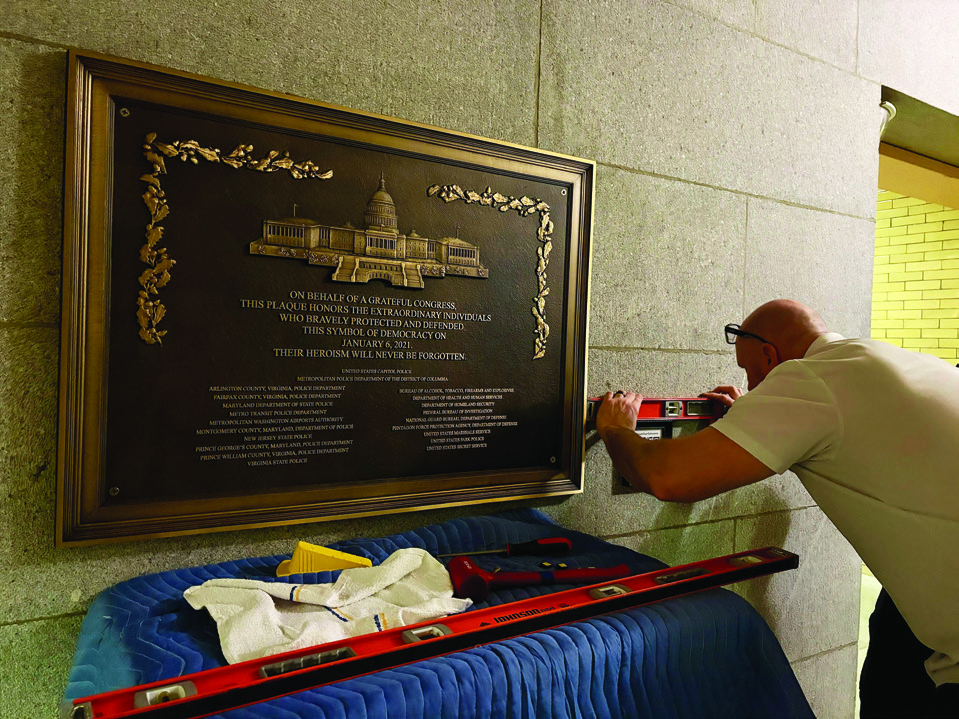


The police officers were taunted and beaten. Some were knocked unconscious and dragged down stone steps, tear gas stinging their throats, to chants of “U.S.A.! U.S.A.!” on Jan. 6, 2021, as hundreds, then thousands, swarmed the citadel of American democracy.
Now, more than five years later, and three years since Congress ignored its own deadline to install it, a memorial plaque recognizing the service of law enforcement that day is finally on display in the very building they defended from a mob of President Donald Trump’s supporters intent on overturning his 2020 election loss.
In the predawn hours Saturday, around 4 a.m., staff with the Architect of the Capitol bolted the bronze plaque to a granite wall near an entrance on the west front, close to where the armed crowd had amassed and scaled scaffolding set up for the inauguration. They wheeled the plaque, stored in plywood, across the stone basement floor and guided it through the double doors. They raised the tribute with a jack table and began fixing it in place, the clang of their tools ringing out through otherwise empty hallways.
There was no announcement, no ceremony, no news cameras – just two employees on their routine overnight shift working while most of Washington slept. The quiet installation, which Congress ordered completed by mid-March 2023, marks the latest turn in the contested effort to remember Jan. 6, as Trump continues to reframe the riot as patriotic and the rioters as victims of a weaponized justice system.
Congress passed a law in March 2022 mandating the installation of a memorial plaque within a year. Instead, the plaque sat in the Capitol basement, surrounded by maintenance equipment. It lists the names of almost two dozen local, state and federal law enforcement agencies including the D.C. police, the U.S. Secret Service, the U.S. Capitol Police, the National Guard and the Maryland and Virginia state police.
Democrats have pressed for implementation in the years since, saying the only thing keeping the plaque from public view was that House Speaker Mike Johnson, R-La., had yet to instruct the Architect of the Capitol – which oversees the complex – to install it. A spokesperson for Johnson at the time argued the project was “not implementable.” Some lawmakers took it upon themselves to memorialize the law enforcement response, mounting copies of the plaque outside their office doors.
Appeals court rules U.S. cannot end protections for 350,000 Haitians
A divided U.S. appeals court has refused to let the Trump administration revoke legal protections that allow more than 350,000 Haitians to live and work in the U.S. and avoid being returned to their gang-violence-stricken country.
A 2-1 panel of the U.S. Court of Appeals for the District of Columbia Circuit late on Friday rejected the administration’s bid to pause a Feb. 2 ruling that blocked the U.S. Department of Homeland Security from ending Haiti’s Temporary Protected Status.
TPS is a humanitarian program that shields eligible migrants from deportation and allows them to work.
Under outgoing Homeland Security Secretary Kristi Noem, the department has moved to end TPS for a dozen countries as part of President Donald Trump’s immigration crackdown, arguing the program was never intended to serve as a “de facto amnesty.”
The administration had asked the D.C. Circuit to stay U.S. District Judge Ana Reyes’ February order while it appeals. Her decision came in a class-action lawsuit brought by Haitians seeking to prevent DHS from exposing them to deportation.
Reyes found that Noem’s November move to end the Haitians’ legal protections likely violated TPS termination procedures and the U.S. Constitution’s Fifth Amendment guarantee of equal protection under the law.
The administration on appeal noted that the U.S. Supreme Court had twice allowed it to end TPS for Venezuelans.
From wire reports